Sew Stitch Embroidery: Quirky, Handmade Charm—Worth the Thread?
First Impressions: A Font That Feels Like a Sketch in Stitch
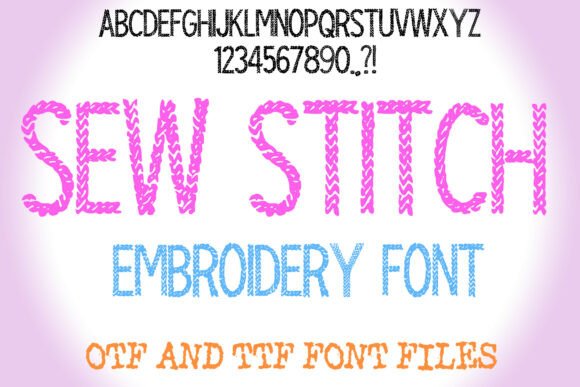
Opening Sew Stitch Embroidery for the first time, I didn’t see a font—I saw a conversation. It’s got that loose, hand-drawn energy: slightly uneven baselines, playful loops on the g and y, subtle stitch-direction cues that suggest needle movement rather than rigid geometry. This isn’t a crisp monospace or a polished script—it’s decorative with intention. It leans into imperfection, like someone stitched it freehand while humming. That’s its strength—and its first real test.
Real Project Test: A Custom Tote Bag for a Local Bakery
Last week, I used Sew Stitch Embroidery to letter “Hearth & Crumb” across the front of a natural canvas tote for a small-batch bakery client. No appliqué, no fill-heavy blocks—just clean satin-stitched letters, each about 3.5 inches tall, spaced with breathing room. The result? Warm, approachable, unmistakably handmade. Customers stopped mid-aisle to ask where it was made. That’s not just charm—it’s commercial resonance. Sew Stitch Embroidery doesn’t shout; it invites touch, invites reading, invites connection. It’s ideal for boutique branding, nursery decor, or personalized gifts where authenticity matters more than precision.
Where It Shines (and Where It Asks for Help)
Sew Stitch Embroidery thrives on stable, medium-weight fabrics: cotton tea towels, twill aprons, brushed cotton sweatshirts, linen pillow covers. On those surfaces, the slight irregularity reads as craft—not error. It holds up beautifully on curved seams (like the front panel of a cap) when digitized with gentle underlay and moderate stitch density. I’ve also used it successfully on baby onesies—paired with soft pastel thread colors and light tear-away stabilizer—to keep the whimsy gentle and skin-safe.
But it’s not universally forgiving. On thin or stretchy fabric—think lightweight jersey tees or silk-blend scarves—the looser line weight and open spacing can blur during hooping or stitching. Tiny lettering (under 1.75 inches tall) loses legibility fast; corners soften, and fine details like the tail of the Q or inner loop of the B risk disappearing into fill stitch bleed. And on dark fabric? Contrast becomes critical—light thread works, but avoid pale yellow or ivory unless you’re using a high-contrast stabilizer underneath.
Design Notes from the Hoop
- Always test on scrap fabric first—especially if pairing with textured weaves (burlap, heavy terry) or layered garments (reversible jackets).
- Review stitch density before sending to machine. Sew Stitch Embroidery leans lighter than standard fonts, so dense fills may need manual adjustment to preserve its airy feel.
- Confirm hoop size compatibility. While flexible in layout, tight curves or tall ascenders/descenders may push vertical limits in smaller hoops (4x4”). Plan your word length accordingly.
- Inspect small details at 200% zoom—not just on screen, but in your embroidery software’s stitch simulation. Does the R’s leg land cleanly? Does the A’s crossbar read clearly at 2.5" height?
- Test black-and-white mockups before finalizing. Sew Stitch Embroidery’s personality relies heavily on contrast and shape—not just color—so grayscale previews reveal clarity gaps early.
- Compare light vs. dark fabric backgrounds in printable mockups. What reads sweet on oatmeal linen might vanish on charcoal denim without a subtle shadow or backing stitch.
- Use appropriate stabilizer: medium-weight cutaway for knits, tear-away for stable wovens, and fusible + tear-away combo for lightweight linens.
Commercial Use & Craft Business Fit
As an Etsy seller and small shop product developer, I treat every font like a brand extension. Sew Stitch Embroidery fits seamlessly into collections built around warmth, storytelling, and tactile appeal—think holiday embroidery kits, personalized baby embroidery bundles, or small-batch apparel lines for independent cafes and bookshops. It adds perceived value: customers recognize effort, care, and design thought. That translates directly to trust and repeat orders.
But here’s what I tell fellow craft business owners: Sew Stitch Embroidery is not a drop-in replacement for technical or high-legibility needs. You wouldn’t use it for medical lab coats or corporate event swag where clarity trumps character. Save it for products where personality *is* the selling point—custom embroidered patches for craft fairs, handmade kitchen towels sold in local boutiques, or wedding gift sets with monogrammed linen napkins.
Final Thought: It’s Not Just a Font—It’s a Design Decision
Using Sew Stitch Embroidery means choosing mood over monotony. It signals to your customer: “This was made with attention—not automation.” That resonates deeply in today’s handmade market. But it also asks something back: intentionality. Intentional fabric choice. Intentional stabilizer. Intentional thread pairing. Intentional scale.
If you’re preparing a digital embroidery file for sale, double-check licensing terms before bundling Sew Stitch Embroidery into kits or offering it as part of a commercial embroidery service. As a designer, I always verify whether the font supports both personal and commercial embroidery projects—especially if you plan to sell finished products or digital design assets on platforms like Creative Market or Etsy.
Bottom line? Sew Stitch Embroidery earns its place in my working library—not as a default, but as a deliberate choice. When your next project calls for heart over horsepower, when your client wants something that feels stitched, not stamped—that’s when you reach for it.