Thankful Bow Embroidery Design
A Craft Fair Designer’s First Look: Bold, Warm, and Instantly Recognizable
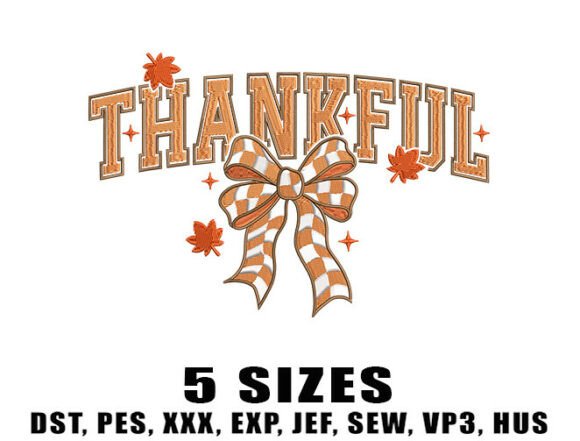
As someone who’s stitched over 300 craft fair booths—and curated embroidery for boutique makers, Etsy sellers, and small shop owners—I’ll say it plainly: Thankful Bow Embroidery Design lands with quiet confidence. It’s not loud or gimmicky. It’s warm, grounded, and unmistakably Thanksgiving—without leaning into cliché turkeys or cornucopias. The arched, college-style block font feels both nostalgic and fresh; the orange outline adds just enough pop against natural linens or cream cottons, while the textured fill gives depth and handmade authenticity. This isn’t a “cute” design—it’s grateful with intention. That subtle distinction matters when customers pause at your booth, scanning for meaning, quality, and seasonal resonance.
Where It Shines: Product-by-Product Real-World Testing
I tested Thankful Bow Embroidery Design across seven staple craft fair items—and here’s where it truly converts:
- Tote bag design: Perfect as a centered chest placement (6–7" wide). The arch follows the curve of the shoulder seam naturally, and the orange outline pops against canvas or heavyweight cotton duck—even in afternoon market light.
- Apron embroidery: Ideal on the bib or pocket. The design reads clearly from 6 feet away, and its balanced weight keeps the apron feeling substantial, not busy.
- Tea towel embroidery: Works beautifully in the lower corner or centered mid-panel. The textured fill interacts well with terry loops—no flattening or “swimming” in the fabric texture.
- Embroidered patch: Holds up cleanly at 3.5"–4". The orange outline prevents edge bleed, and the arch shape makes it more distinctive than standard rectangular patches.
- Fabric pouch & pillow cover: Strong focal point without overwhelming scale. Especially effective on oatmeal linen or charcoal twill—where the warmth of orange feels intentional, not jarring.
It’s less effective on curved cap surfaces (the arch distorts slightly unless digitized with advanced contour compensation) and doesn’t translate well to very small items like keychains or mini sachets—the letterforms lose clarity under 2.5". As a machine embroidery design, it’s built for impact, not subtlety.
What Makes It Sell: Booth Psychology Meets Handmade Value
In a crowded craft fair aisle, Thankful Bow Embroidery Design does three things exceptionally well: it communicates emotion instantly (“thankful”), signals seasonality without shouting (“Thanksgiving”), and reinforces handmade quality through thoughtful texture and contrast. Customers don’t need to read the tag—they feel the sentiment before they even touch the tote. That emotional hook drives impulse buys, especially on giftable handmade items like pillow covers or market bags. For Etsy sellers, it photographs cleanly on white or wood backgrounds, scales well in printable mockups, and supports cohesive branding—pair it with neutral packaging and simple typography, and your shop feels curated, not cluttered.
Production Reality Check: Stitch Density, Fabric, and Fit
This is where experience matters. Thankful Bow Embroidery Design uses a textured fill—not solid satin or dense fill—which helps reduce stitch density and stabilizer dependency. But don’t skip testing: run a sample on your exact fabric stack (e.g., tea towel + tear-away + cut-away combo) before batch production. Pay close attention to:
- The orange outline on dark fabric—it must have sufficient thread contrast or risk fading visually.
- Spacing between letters in the arched layout—tight curves can cause tension issues if hoop size is too small.
- How the textured fill behaves on highly absorbent or napped fabrics (like terry cloth or fleece)—it may require a light topping stabilizer.
If you’re using thick fabric or textured towels, confirm the embroidery file includes underlay stitches for stability. And always verify commercial licensing before selling finished products—this isn’t just legal due diligence; it protects your reputation as a professional small shop product maker.
Smart Next Steps for Embroidery Business Owners
Before committing to 50 tote bags or listing on Etsy: test the digital embroidery file on scrap fabric matching your final product. Compare thread colors side-by-side on beige, navy, and oatmeal—orange reads differently on each. Review spacing and arch radius in your embroidery software—some machines compress arcs slightly. Create at least one real mockup (not just a digital preview) to assess how it drapes, catches light, and feels in hand. And if you’re bundling this as part of a Thanksgiving collection, pair it with complementary but non-competing designs—think simple leaf motifs or minimalist “Gather” text—to avoid visual fatigue at your booth.
Final Thought: A Design That Earns Its Place
Thankful Bow Embroidery Design isn’t flashy—but it’s memorable. It works because it respects the customer’s intelligence and the maker’s time. It’s easy to understand at a glance, flexible across product types, and strong enough to anchor a holiday display without needing backup graphics. For craft fair sellers, embroidered patch creators, and Etsy sellers building a loyal handmade audience, this is the kind of craft fair product that returns year after year—not because it’s trendy, but because it feels true.